
Louis Martin Custom Knives
Handmade Damascus Knives for Sale
Damascus knives are hand-forged blades made by folding and welding multiple layers of steel together, creating a distinctive wavy or flowing pattern on the blade. Louis Martin's Damascus knives are crafted from high-carbon steel alloys using traditional pattern-welding techniques perfected over three generations.
Quick Answer
Damascus knives are hand-forged blades made by folding and welding multiple layers of steel together, creating a distinctive wavy or flowing pattern on the blade. Louis Martin's Damascus knives are crafted from high-carbon steel alloys using traditional pattern-welding techniques perfected over three generations.
Damascus steel has captivated knife enthusiasts for centuries. At Louis Martin Custom Knives, we carry on the ancient tradition of pattern-welding: folding, twisting, and forging multiple steel alloys together to produce blades of remarkable beauty and superior cutting performance. Every Damascus blade we list is the only one of its kind. When a piece sells, it is gone; the next one out of the forge will never carry the same pattern.
Characteristics & Construction
Steel Composition
Our Damascus blades are forged from high-carbon steel alloys, typically 1080 and 15N20, folded to 256+ layers. The alternating nickel-rich and carbon-rich bands create the signature contrasting pattern visible after etching.
Pattern Styles
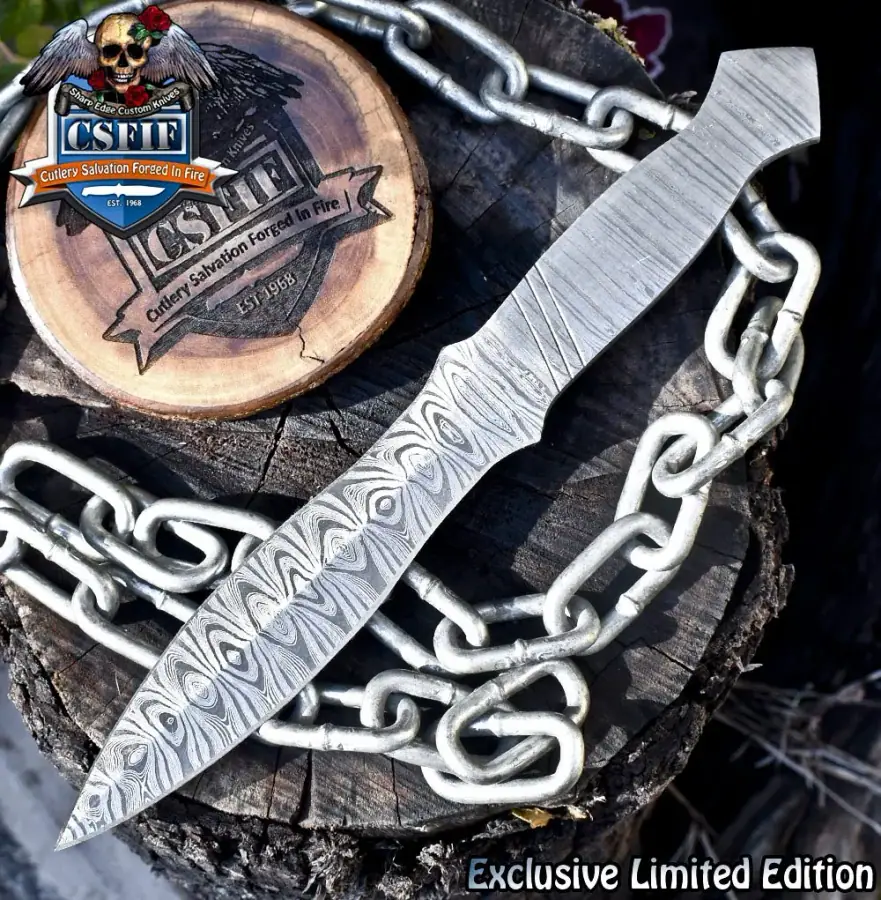
Louis Martin craftsmen produce several Damascus pattern variants: classic ladder, raindrop, twist, and wild random. Each pattern emerges uniquely from the forging process, meaning no two blades are identical.
Handle Materials
Our Damascus knives are paired with a wide range of handle materials: stabilized wood (walnut, rosewood, cocobolo), stag deer antler, camel bone, rams horn, and brass guard fittings, all sourced and fitted by hand.
Edge Retention
High-carbon Damascus steel holds an exceptional edge. The differential hardness across layers, typically 58-62 HRC, means the blade self-sharpens at a microscopic level as the softer layers wear slightly faster than the harder ones.
How We Forge Damascus
Every blade starts as a billet of alternating 1080 and 15N20 steel bars, forge-welded and folded until the layer count passes 256. The billet is then drawn out, shaped, normalized, and quenched before a ferric-chloride etch reveals the pattern the folds created. We have run this process at our own facility since 1993, and no automation touches the blade between billet and final edge.
The Patterns You Will Find Here
Ladder, raindrop, twist, and wild random patterns each come from a different manipulation of the billet before final forging. A ladder pattern is ground and re-forged in ridges; raindrop is drilled and flattened; twist is exactly what it sounds like. Because the pattern forms inside the steel, no two etches ever match, which is why every listing in this collection is photographed individually: the knife in the photo is the knife you get.
Choosing Your First Damascus Knife
Hunters usually start with a fixed-blade skinner or drop-point hunter for easy maintenance in the field. Cooks reach for a Damascus chef knife, where the layered steel takes a razor edge. For everyday carry, a Damascus folder keeps the pattern in your pocket. Collectors gravitate to bowies and karambits, where the larger canvas shows the pattern best. Every category page shows live, in-stock pieces.
Built to Be Used
Damascus has a reputation as shelf art, but pattern-welded high-carbon steel was always a working material. At 58-62 HRC our blades hold an edge through real field use, and the care routine is simple: wipe dry, oil lightly, sharpen on a whetstone. Follow the care guide below and the blade will outlast its first owner. The warranty card in every box is not decoration.
 Made to Order
 Assorted Lot
Damascus Knives — 10-Piece Lot
A hand-picked assortment of 10 damascus knife pieces, hand-forged to order in East Northport, NY. Perfect for resellers, gifts, or building a collection. Always available — no waiting on stock. Tell us what you need and we'll confirm options and pricing.
Also available on our eBay store (Top Rated, 110K+ sold), Amazon & Etsy storefronts, in our daily live Whatnot auctions (4.8★, 11,200+ reviews), at gun & knife shows, and for wholesale volume. Carry rules vary: see knife laws by state.
Care & Maintenance
Full care guide →- 1
Clean after each use
Wipe the blade clean with a soft, dry cloth immediately after use. Avoid soaking in water; high-carbon steel is reactive and can spot or rust if left wet.
- 2
Dry completely
Ensure the blade is completely dry before storage. Moisture between the blade and sheath is the leading cause of surface oxidation on Damascus steel.
- 3
Apply food-grade mineral oil
Lightly coat the blade with food-grade mineral oil or camellia oil after cleaning. This creates a barrier against moisture and prevents the etched pattern from dulling.
- 4
Sharpen on a whetstone
Use a fine-grit whetstone (1000/3000 grit) at a consistent 15–20° angle. Avoid pull-through sharpeners; they remove too much metal and destroy the Damascus pattern near the edge bevel.
- 5
Store in a dry environment
Store Damascus knives in a dry location, ideally on a magnetic knife strip or in an oil-treated leather sheath. Avoid humid environments and plastic sheaths that trap moisture.
Damascus Knives — Frequently Asked Questions
What is Damascus steel?
Is Damascus steel stronger than regular steel?
How do I prevent rust on my Damascus knife?
Can Damascus knives be used for everyday carry (EDC)?
How many layers does a Louis Martin Damascus blade have?
What is the difference between Damascus and stainless steel knives?
How long does it take to make a Louis Martin Damascus knife?
How much do handmade Damascus knives cost?
How can I tell real Damascus from a printed pattern?
Do you sell Damascus knives wholesale?
Related Articles
One of a kind
Each piece is the only one we made. Sold once, gone for good.
Hand-forged since 1993
Forged, ground, and finished at our own facility.
Warranty in the box
Every knife ships with our warranty card.
Free US shipping
Dispatched within 3 business days.
What Live Buyers Say
"Excellent build quality and craftsmanship!!"
"Nothing but beauty and fine quality..! Everyone should own some of these knives...!"
"great packaging and great over all product. shipped fairly quickly will definitely be buying from this guy again"
Own one of our damascus knives? Leave a review
Inquire About Damascus Knives
Tell us your requirements and we'll respond within 24 hours.
Related Knife Types
Not sure what to expect?
See how our process works →Prefer to call?
(631) 672-9816