
Gifts for Knife Collectors: What to Buy, From the Makers Who Forge for Them
Quick Answer
Gift ideas for knife collectors from makers who forge for them: Damascus blades, historical replicas, custom commissions, and how to spot real quality.
The best gift for a knife collector is a hand-forged, one-of-a-kind blade they could not simply order off a shelf. A Damascus fixed blade with a bone or stag handle is the safest choice, a historical replica or custom commission the most memorable. Mass-produced knives rarely excite someone who collects.
We have been hand-forging knives since 1993, and a good share of the blades that leave our shop are bought as gifts. Anniversaries, retirements, groomsmen, Father’s Day, and every December, a wave of people shopping for the collector in their life. We also talk to those collectors every week, so we know what actually earns a place in a display case and what gets politely set in a drawer. This guide is everything we tell gift buyers who ask us for help.
What Makes a Knife Collectible in the First Place
Before picking a gift, it helps to understand what collectors are actually hunting for. Four things come up again and again.
Hand-forged construction. A blade shaped by hammer and forge carries the marks of a person’s judgment: the grind lines, the taper, the balance. Collectors can tell the difference between forged work and a blade stamped out by machinery, and they value the former.
One of a kind. Serial-numbered factory runs of ten thousand identical knives hold little pull. A piece that exists once, and only once, is a different thing entirely. It cannot be replaced, only owned.
Natural materials. Bone, stag, walnut, wenge, olive wood, camel bone. Natural handle materials age, develop character, and never repeat their figure or grain. Synthetic scales have their place on working knives, but collectors reach for the natural stuff.
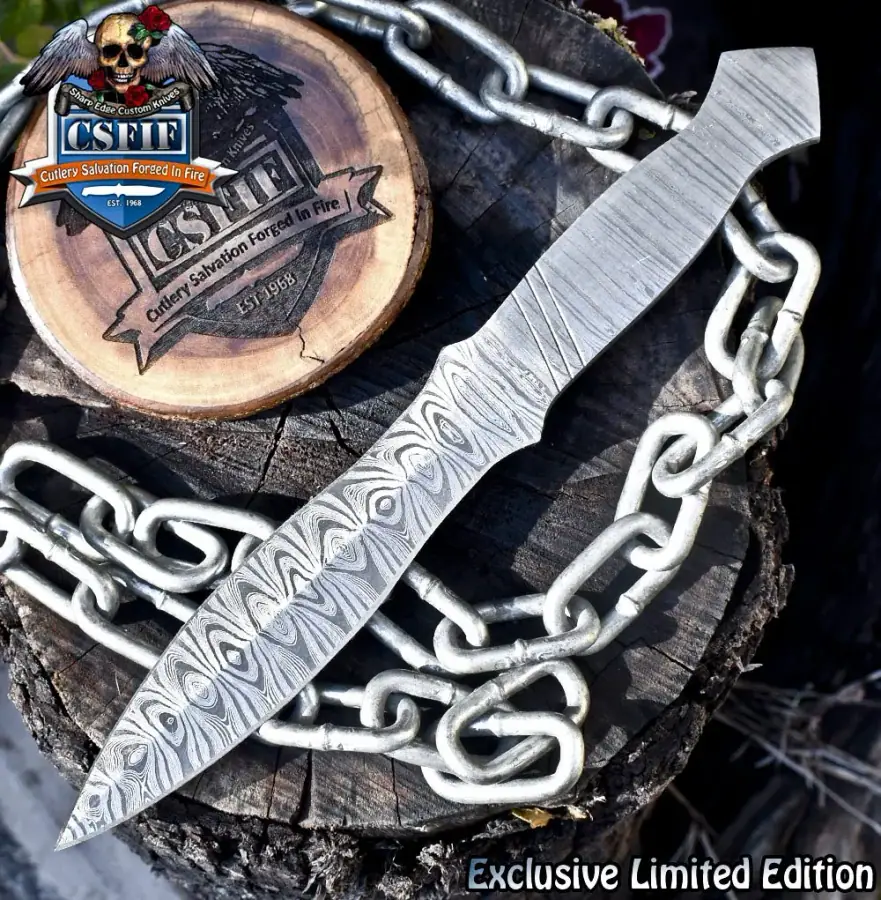
Pattern-welded steel. Damascus steel, made by forge-welding and folding layers of contrasting steels, produces flowing patterns of raindrops, ladders, twists, and waves. The pattern is born in the forge, unique to that bar of steel, and it is the single biggest reason Damascus dominates the collector market.
A gift that checks even two or three of these boxes will land well. A gift that checks all four is the kind collectors remember who gave it to them.
Gift Ideas by Collector Taste
If you have seen their collection, or heard them talk about it, match the gift to the pattern of what they already love.
For the Damascus Pattern Lover
Some collectors are in it for the steel itself. They will turn a blade under the light for minutes, following the layers. For them, choose a piece where the pattern is the star: a full-size bowie, a hunter, or a chef knife with a bold twist or raindrop pattern. Browse our Damascus knives and pick the pattern that stops you when you scroll. If it catches your eye as a non-collector, it will catch theirs.
For the History Buff
Plenty of collectors organize their cases around eras and cultures, and a well-made replica of a historical pattern is a gift with a story attached. A Viking-age seax is a favorite, and our seax knife guide covers what makes the pattern authentic. A Scottish dirk suits anyone with Highland roots, a WW1 trench knife speaks to military history collectors, and a curved jambiya brings centuries of Middle Eastern craft to a display shelf. We forge all of these patterns, and we have written full guides to each, so you can learn enough in ten minutes to buy with confidence.
For the Traditional Pocket Knife Collector
Slipjoint collectors are a devoted bunch, and the patterns they chase are older than any of us. A hand-finished barlow, with its long bolster and teardrop handle, is the classic of classics; our barlow knife guide explains why the pattern has ridden in American pockets for two centuries. Trappers, stockmans, and canoes are equally safe. Start with our pocket knives and favor natural bone or stag covers over synthetics.
For the Collector Who Displays
Some pieces are made to be looked at. Daggers, with their symmetric double-edged blades, are the most display-friendly knives ever devised, and a Damascus dagger on a stand anchors a shelf the way a painting anchors a wall. Full-length swords make an even bolder statement for the collector with the space. And for something quieter and more personal, a scrimshaw piece, with a scene hand-etched into a bone handle, is functional art; our scrimshaw knives guide shows what the craft looks like when it is done right.
Why One of a Kind Beats Mass-Produced for Gifting
Here is the honest truth about gifting to a collector: they already know the factory catalogs. If a knife can be bought in unlimited quantity with two clicks, they have either bought it or decided not to. You cannot surprise them with it.
A hand-forged piece changes the math. The pattern in a bar of Damascus never repeats, so the blade you give exists nowhere else on earth. That transforms the gift from a product into an event. It also sidesteps the awkward possibility of duplicating something they own, because by definition, they cannot already have it. And years later, when someone asks about the knife in the case, the answer is a story about you, not a model number.
How to Pick When You Do Not Know Their Collection
Buying blind is where most gift shoppers freeze. Do not overthink it. Two safe bets cover almost every collector:
- A Damascus fixed blade. Fixed blades are the backbone of nearly every collection, and pattern-welded steel is admired across all collecting camps. A hunter or bowie in the 8 to 12 inch overall range is the sweet spot: substantial enough to display, practical enough to use.
- Bone or stag handles. When in doubt on materials, natural wins. Stag and bone are the traditional collector’s choices, they photograph beautifully, and they pair with every Damascus pattern we forge.
If you want to see how finished pieces look in hand before deciding, our gallery shows real knives from the forge, not renders. Pick the one you keep coming back to.
A note on size and use: you do not need to know whether they hunt, camp, or cook. Collectible knives are bought for the craft first. A blade they never cut anything with can still be the favorite piece in the case.
Authenticity: Make Sure the Damascus Is Real
One warning before you buy anywhere, from anyone. The market is full of cheap blades with a Damascus-style pattern that is only acid-etched or laser-printed onto plain monosteel. The pattern sits on the surface, and it fades or scratches away with use and sharpening.
Real pattern-welded Damascus is different. The layers run all the way through the bar, because the blade was forge-welded from them. Check for these signs:
- The pattern continues over the spine and tang, not just the flats of the blade.
- The maker names the steels in the billet, such as 1095 and 15N20, and describes the forging.
- The pattern has depth and irregularity. Printed patterns look uniform and repeat; forged patterns flow and vary.
- The maker stands behind it. A real forge will tell you exactly how the blade was made, because the making is the point.
Every Damascus blade we sell is genuinely forge-welded, folded, and ground in our shop. If a price looks too good for hand-forged steel, it is.
The Companion Gift: A Care Kit
A small, thoughtful addition that costs little and says a lot: pair the knife with the means to keep it beautiful. A bottle of mineral oil or a quality blade wax, a soft cloth, and a leather strop cover the essentials for carbon Damascus, which rewards a light coat of oil and dry storage. Print or bookmark our knife care guide and tuck a note in the box pointing to it. Collectors take care of their pieces; giving them the tools to do it shows you understand that.
For the Collector Who Has Everything: Commission a Custom Piece
Some collectors are deep enough into the hobby that guessing is hopeless. For them, the strongest gift we know is a custom commission. You choose the blade style, the Damascus pattern, the handle material, and any engraving, initials, a date, a family name, and we forge it by hand to that specification. No other knife like it will ever exist, because it was designed around one person.
Two practical notes. First, lead time: hand forging takes weeks, not days, so start the conversation well before your deadline, especially ahead of the holidays. Second, you do not need to know knives to commission one. Tell us about the person, and we will guide the design from there. Reach out through our contact page and we will walk you through it.
Whatever you choose, choose something made by hand, made once, and made to outlast everyone involved. That is what collectors hunt for. We know, because we have been forging it for them since 1993.
Frequently Asked Questions
What is a good gift for a knife collector? +
A hand-forged, one-of-a-kind knife is the safest strong choice. A Damascus fixed blade with a bone or stag handle suits nearly every collection, because the pattern-welded steel makes each piece unique. If you know their taste, match it: a historical replica for a history buff, a barlow for a traditional pocket knife collector, or a dagger for someone who displays their pieces.
Are Damascus knives worth collecting? +
Genuine hand-forged Damascus knives are among the most collected blades in the world. Because the pattern is created by forge-welding and folding layers of steel, no two blades are ever identical, so each piece is one of a kind. That uniqueness, along with the skill visible in the steel, is what keeps collectors coming back to Damascus year after year.
How do I know if a knife is collectible quality? +
Look at fit and finish first: the guard, bolsters, and handle scales should meet the steel with no gaps or glue lines. Check for a full tang on fixed blades, ask what steel was used and how it was heat treated, and find out who made it. A knife from a known maker or forge, with clean grinds and a pattern that runs through the steel rather than sitting on the surface, is collectible quality.
Can I get a custom knife made as a gift? +
Yes. We take custom commissions and build knives to a collector's exact specification, from blade shape and Damascus pattern to handle material and engraving. Custom work is forged by hand, so allow several weeks of lead time before the date you need it. Reach out through our contact page early, especially ahead of the holidays.
Shop the Collection
Browse our handmade Damascus Knives